50 ways the American family has inverse in the last 50 years
The Cleavers are oft referred to as the archetype American family—and almost 56 years agone, when "Leave it to Beaver" aired its concluding episode, they about certainly were. In those days, the all-American family platonic included a working father, stay-at-home mother, and at least two children living in a home they endemic and all left on Sundays to attend church.
Today, family life looks much different. Women make upwardly nearly as much of the workforce as men, more families are choosing to rent than purchase, church attendance has dropped by nearly 50%, and the cadre family is but as likely to be made up of same-sex parents or cohabiting partners than a heterosexual married couple.
Compiling information from a number of sources, Stacker has rounded up 50 means the American family has inverse in the past 50 years. From who makes up the modern-twenty-four hours American family unit to major aspects of family life, click through the list to see some of the most dramatic differences.
Too: The real cost of raising a family across 50 major metros
People are getting married much older
In 1969, the average woman would get married earlier she could legally drink. Throughout the 1960s, the median age for first-time brides was 20, and the median age for commencement-time grooms was 23. Today the median age for brides is 27; for grooms, it'south 29.
Fewer people are married
As the age of those getting married for the starting time time has gone upwards, the overall number of married couples has gone down. In 1960, 72% of adults over 18 were married, while today, only 51% of adults over the historic period of 18 are married.
More unmarried people cohabitate
One reason for this reject is the number of couples who are choosing to live together without exchanging rings. In the 1960s, fewer than 500,000 unmarried couples were living together before or instead of getting married. Past 2012, there was a 900% increase in cohabiting couples; U.S. Census data from that yr revealed that 7.8 million couples were living together without having walked downwardly the aisle.
ThiagoSantos // Shutterstock
Divorce has risen and fallen
Between 1960 and 1980, the then-called "crude divorce rate" in America leapt from 2.two to 5.2, making for a startling 136% increase. Simply divorce has been trending downwards since the early 1990s, particularly among millennials who are marrying later.
More children live with divorced parents
In 1969, nearly all children remained in the home of their married parents until reaching adulthood. Today, less than one-half of all children make it to 18 in a family unit headed by their married parents.
Roman Samborskyi // Shutterstock
At that place are more composite families
Data on blended families didn't become available until the early on 1990s. However, information technology is now known that one in six (or 16%) of children are living in blended families. These households have a step-parent too equally a step-sibling or half-sibling. While data is not available for blended families in 1969, information technology's likely that the number was far lower as the result of a lower divorce charge per unit.
Same-sex wedlock has been legalized
In 1969, obtaining a marriage license as a same-sexual activity couple only wasn't an option. More often than not speaking, overall visibility for same-sex activity couples was lower, with fewer couples choosing to live openly as partners due to societal norms. In 2015, the legalization of same-sex marriage finally afforded same-sexual practice couples legal status and dramatically increased the number of reported households fabricated upwardly of aforementioned-sexual practice partners.
Get-go-fourth dimension mothers are getting older
For many married couples in the 1960s and '70s, having children was a priority, and one they didn't wait long to begin working on. The boilerplate historic period for first-time mothers in the 1970s was 21. In 2015, many women chose to await longer to go parents, and the boilerplate age of kickoff-time mothers has jumped to 27.
Monkey Business Images // Shutterstock
More mothers pursue boosted education
One reason women await to have children is and then they tin further their instruction. In the 1960s, only 18% of new mothers had any college instruction. These days, 67% of mothers with infants at home take at to the lowest degree some college under their belts, even if they don't take a diploma from a 4-year plan.
Family size is decreasing
Due peradventure in part to the older age of first-time parents, many families are having fewer children. In the 1970s, xl% of families reported having 4 or more children. Today, 41% of families have only two children, with just fourteen% having iv or more. Additionally, the number of families with a single kid doubled from 11% in 1976 to 22% in 2015.
Monkey Business concern Images // Shutterstock
The number of working mothers is increasing
In the tardily 1960s, about 50% of women were stay-at-home mothers. Since then, family life has been greatly afflicted by the movement of mothers into the workforce. In 1975, the first twelvemonth with bachelor data on mothers in the workforce, less than one-half of mothers with children under 18 held a full-time or part-time job, and less than one-third of mothers with children under 3 worked outside of the home. By 2015, 70% of mothers with children under eighteen and 64% of mothers with children under three held jobs. The desire to go along working into parenthood has been a major gene in smaller family sizes.
Rawpixel.com // Shutterstock
Families are attending church building less frequently
While regular church building omnipresence peaked in the late 1950s, the vast majority (well over 50%) of families still regularly attended church building each week well into the 1960s. Equally of 2014, only 36% of adults reported that they and their families attended church weekly. One reason more people are staying home on Sundays? The logistics of going to church, after a full of piece of work week for both parents, are too overwhelming.
Rob Painter // Shutterstock
Firm size has increased
Surprisingly, as family sizes accept gone downwardly, habitation sizes have gone upward. In 1973, the first year with available Census data, the average size of the family unit home was 1,660 square anxiety. Today, houses have hit an average all-time high of 2,679 foursquare feet.
Andriy Blokhin // Shutterstock
More families are renting homes
For many families, owning a dwelling house has ever been a major part of their "American Dream." In the early 1970s, 62.9% of families owned their own homes, a rate that continued to increase until the early on 2000s. Due to the rising costs of unmarried-family unit homes, economic downturns, and other factors, renting is on the rise once more. Over the past decade, homeownership declined past three.half-dozen 1000000 families, while the number of families living in rentals increased by ane.ix meg.
Max Topchii // Shutterstock
Family incomes are higher
According to the U.S. Bureau of the Census, the median family unit income in 1969 was $55,916 (adjusted for inflation). In 2017, the median family income was $75,938. That means over the by 50 years, most American families accept lived well within the bounds of the wealthiest i% of the world.
Pregnant workers take legal protection
The $20,000 increase in the median family income is partially due to the Pregnancy Discrimination Act, which was passed in 1978. Earlier then, women could be (and often were) fired from their places of employment once it became clear they were pregnant. This cutting off an unabridged acquirement stream for many families. Now that the right to work is legally protected for both parents, many families take seen a pregnant and lasting increase in their income.
Family vacations are on the rise
Many people have nostalgic memories of family unit vacations, a phenomenon that began in the 1960s with the evolution of the Interstate Highway System and increment in a family unit'south expendable income. Today, the boilerplate family has more expendable income than they did in 1969, and they're using it for fifty-fifty more family vacations. In 2017, 35% of families took at least one family vacation, with the old-school road trip even so the most common blazon of holiday.
Families are safer on the road
Today'due south drivers can become a ticket for non wearing their seat belts properly; seat chugalug laws took event in 1983. But in the early 1970s, as families embarked on their annual road trips, it was not uncommon for the kids to exist without a seat belt or to have the smallest children sitting front end and center between their parents—things you definitely wouldn't see on a family holiday today.
Monkey Business Images // Shutterstock
More than families are watching TV
Expendable income isn't simply existence spent on family vacations. Many families are choosing to spend their extra dollars on other forms of entertainment, like television. In 1969, at that place were 58.25 million television homes in the state. In 2018, there were 119.6 one thousand thousand television homes in the state. Every bit a whole, Americans are spending more fourth dimension around the tube.
Monkey Business Images // Shutterstock
Family dinners are a affair of the past
While American families spend more time watching TV together today than they did 50 years ago, they're spending far less time eating dinner together. Family dinners were an almost nightly ritual in most homes during the 1960s and '70s, but a recent survey revealed that twoscore% of modern families but eat dinner together 3 times or less each week.
Pablo Merchán Montes // Unsplash
Fewer families eat home cooking
Not all recipes from the late 1960s and '70s were winners—for example, Ham and Bananas Hollandaise—only that didn't terminate Americans from cooking almost all their meals at home. Not so today. With 45% of people claiming to hate cooking, the average family is now spending $3,008 a year dining out.
Jakub Cejpek // Shutterstock
Obesity is on the ascension
Obesity has been steadily increasing over the past 50 years. In 1970, merely near xv% of Americans were considered obese. Equally of 2016, nigh forty% of American adults encounter the markers for existence obese.
Less is being spent on habiliment
Families are spending significantly less on article of clothing than they were 40 years ago. In 1972, the average family defended 8.iv% of their budget to clothing, while well-nigh families today have lowered that figure to 3%. A dramatic increase in housing costs is thought to exist a major factor in the upkeep adjustments.
Fewer children live in a two-parent household
In the tardily 1960s, the "core" family was withal very much intact, with well-nigh 87% of children living in a 2-parent dwelling where both parents were in their first marriage. In 2018, only 46% of children were living in the aforementioned type of domicile, giving new meaning to core family unit.
SpeedKingz // Shutterstock
More adults alive in their babyhood habitation
Blame it on the economy, or the fact that people are getting married subsequently, but for the first time since 1880, more adults are living with their parents in their babyhood domicile rather than on their own. In 1960, merely 20% of young adults notwithstanding lived at home with mom and dad. In 2018, that number jumped to just over 32%—a college percentage than those living with a partner, spouse, or roommates.
There are more interracial families
In 1967, the U.S. Supreme Court ruled that interracial marriage was legal across the country in the Loving vs. Virginia instance. The same year, just 3% of newlyweds were married to someone of a different race or ethnicity. By 2017, one in 6 newlyweds, nigh 17%, were married to someone of a different race or ethnicity, making for a significant increase in interracial families.
Evgeny Atamanenko // Shutterstock
Families struggle for quality time
According to a survey of 2,000 parents, the boilerplate family unit spends merely 37 minutes together each day. While many families feel that corporeality of time is far too lilliputian, other research reveals an encouraging trend. Fathers have seven times more quality time with their children at present than they did in 1974 (five minutes a day then vs. 35 minutes a twenty-four hours now), and mothers spend iv times as much quality time with their children (15 minutes in 1974, vs. i hr in 2017).
EpicStockMedia // Shutterstock
Fewer families include children
From 1967 to 2016, the percentage of adults living without children skyrocketed from 52.5% to 71.3%. Contributors to this tendency include an crumbling population, decreased fertility rates, and a pregnant shift in living arrangements—specifically, a 44% turn down in adults cohabiting with spouses.
Halfpoint // Shutterstock
Men are helping more with housework
Fifty years ago, most women were stay-at-dwelling house mothers. They also did nearly all of the housework, from vacuuming the living room to completing the grocery shopping, while men simply did ii hours of chores a calendar week. Today, men accept become a little more accustomed to housework, spending four hours on chores each week (a number that has held steady since the mid-1990s).
Africa Studio // Shutterstock
Families are reading less
With the ascension of TV and the cyberspace, it's probably unsurprising that families are spending far less time reading today than they did fifty years ago. In 1978, only viii% of Americans hadn't read a volume in the past year. In 2014, almost a quarter of Americans went the entire year without reading a book. Parents are spending less fourth dimension reading to their children likewise, with experts warning the miracle could pb to an overall subtract in literacy.
People are getting their news differently
Many children born in the 1960s and '70s can probably recall being sent outside to fetch the newspaper first thing in the forenoon, so their parents could read it with breakfast. Today, you'd exist hard pressed to discover a kid with that job. In 1973, 63.147 million families received a daily newspaper. In 2014, just 40.42 million families subscribed to a physical newspaper. Meanwhile, more than families watch the news on TV than ever before.
LightField Studios // Shutterstock
Pet ownership has quadrupled
Pets are an integral role of most American families. In fact, pet ownership in this state has about quadrupled since the 1960s. Now, 36.5% of households own a dog and 30.four% own a cat, with birds, horses, and fish rounding out the list of almost popular family pets.
Nascency control is more than readily available
In the early 1960s, couples didn't have many options when it came to contraceptives. Condoms, abstinence, medically questionable practices, and crossed fingers were the most frequently employed ways to brand certain that a couple didn't offset a family before they were prepare. But when the FDA approved the commencement oral contraceptive pill in 1960, things became a bit simpler. Within 5 years, millions of women were on the pill, and newlyweds had much better control over the timing of their commencement child.
Lorie Shaull // Wikimedia Commons
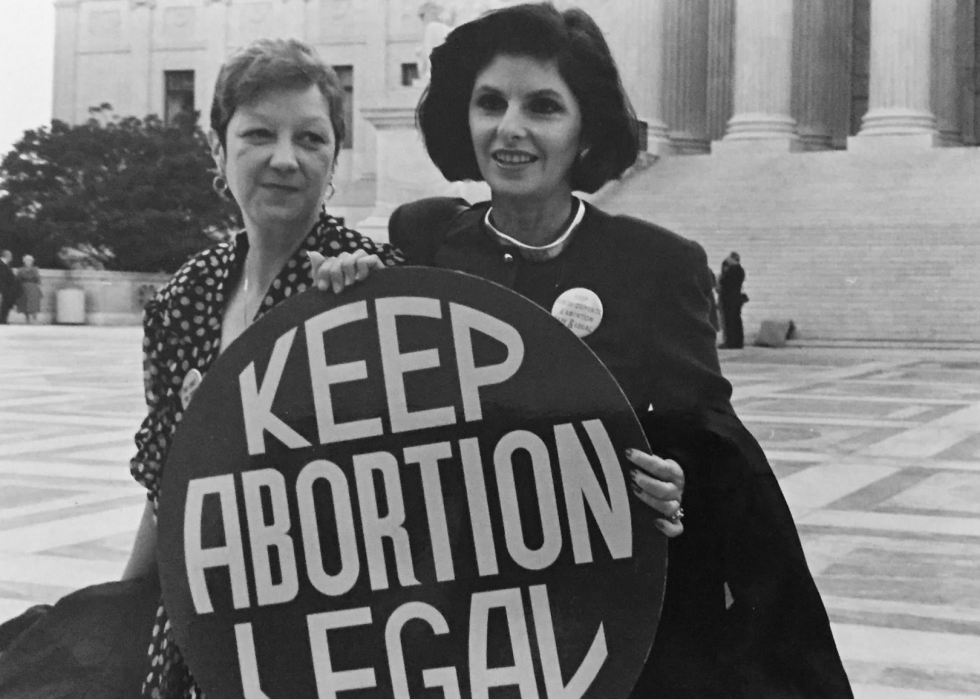
Ballgame has been legalized
When the U.S. Supreme Court decided Roe v. Wade in 1973, women gained the correct to a legal ballgame and hundreds of abortion clinics opened around the country. American families were now given one more than way to decide when, or if, they wanted to start a family.
Pressmaster // Shutterstock
Mental illnesses are more visible
In the 1960s and '70s, mental illnesses were only not talked nigh. Those who suffered from them chose to deal with them every bit a private thing and rarely sought treatment. Today, the conversation effectually mental illness has become more open, and the stigma surrounding it has begun to fade. Families now may be more than inclined to seek treatment for members who suffer from mental affliction.
Valeri Potapova // Shutterstock
Health care costs are rising
In 1969, $65.9 billion was spent on health care for American families, a total cost of $318 per person. In 2017, $3,492.1 billion was spent on wellness intendance in total, making for a cost of $10,739 per person.
Dmytro Zinkevych // Shutterstock
There are more than multigenerational families
From 2000 to 2016, the number of multigenerational homes in America rose by 21.half-dozen 1000000 to 64 million. The number of multigenerational families living under i roof is nigh double what it was in 1950 (32.2 million) and significantly college than what it was 50 years ago.
pikselstock // Shutterstock
Life expectancy is going up
A slice of good news: Those born in 2019 accept a much longer life expectancy than those born in 1969. If you were built-in that yr, your life expectancy from birth was 74.four years. For those born this twelvemonth, it'due south expected to be betwixt 76 and 81. Fifty-fifty though people are getting married and having children later, they may end up spending just every bit much time as parents or spouses equally those in the previous generation.
View Apart // Shutterstock
People are retiring later
Possibly a side effect of living later, people are also working longer. In 1970, the average retirement age was 65. Today, many in the workforce are holding down jobs until at to the lowest degree 66, with fifteen% of them choosing to go along working after that. Many children in 1969 had retired grandparents, while many of today's children do not—at least non yet.
Liudmila Fadzeyeva // Shutterstock
Giving nascency has become easier
The lumbar epidural became the preferred technique for pain direction during childbirth in the 1960s. The '70s and '80s saw many improvements in injection, then that between 1981 and 2001, its employ in U.Southward. hospitals tripled. By 2001, threescore% of women had an epidural while giving birth, making the process of bringing a child into the world much less painful.
More births are happening outside of wedlock
Only about 10% of all births in 1969 were exterior of a marriage. For many, having a child out of wedlock was shameful, and something that afflicted your social standing. Today, attitudes toward births outside of union have profoundly relaxed, and almost xl% of births in 2016 were to unmarried mothers.
MarijoAH12 // Wikimedia Eatables
Teen pregnancy rates are down
Teen pregnancy rates have been at an all-time low for the past xxx years. While not many teens were expecting children of their own in 1969, the 1990s saw a sharp fasten in the number of teenage mothers; 59.ix out of every 1,000 births were attributed to a teen girl betwixt the ages of 15 and 19. As of 2016, in that location was a 67% drop in the number of teen mothers, with only xx out of every one,000 new mothers existence a teen.
New Africa // Shutterstock
There's a steady refuse in 'the help'
In the 1960s, information technology wasn't uncommon for the average family to have a housekeeper, or "help," responsible for many housekeeping and kid-rearing tasks. By the 1970s and '80s, advances in kitchen appliances and the availability of fix-made nutrient made having paid help less necessary—unless you belonged to a certain social class with a large household to maintain. Today, fewer households have paid help, which tin leave many parents feeling more stressed out than ever earlier.
Rawpixel.com // Shutterstock
The number of children in 24-hour interval care is upwards
Since well-nigh parents have jobs, they take to find some sort of child care for their young children. In 1973, that meant that about children received care in their homes from a relative or not-relative (30.ix% and 29.4%, respectively). Past 2012, 25.9% of children were spending their days in a day care center—a huge spike from the 13% who were in day care in 1973.
Alexander Dummer // Unsplash
More parents are turning to books for help
Parents in the 1970s rarely relied on parenting books to raise their immature children, instead turning to those they knew personally for communication. But by the '90s, there were 5 times as many parenting books available, a trend that'southward carried on into 2019. Today, at that place are hundreds of philosophies about parenting, and as raising children becomes more competitive, many new parents find themselves turning to books rather than their real-life counterparts.
Brian A Jackson // Shutterstock
Physical punishments for children are down
As recently as 20 years ago, physical subject like spanking was an acceptable method of penalisation for children. Today, research has accumulated illustrating a connection between physical bailiwick and negative development, making punishments like spanking frowned upon. They are generally used less frequently by modernistic parents than they were past parents fifty years agone.
Austin Customs Higher // Flickr
More than families identify importance on higher education
L years ago, parents didn't place that much importance on their children going to higher. In 1969, only 8.1% of female and thirteen.vi% of male high school seniors went on to obtain a four-year degree. Today, about 4 in 10 parents place a high value on their children attention higher, and in 2017, 34.half-dozen% of female and 33.vii% of male loftier school seniors went on to complete a four-yr degree.
wavebreakmedia // Shutterstock
More children are receiving a public education
From 1950 to 1965, following the desegregation of public schools, private schools saw an almost 100% increase in enrollment. From 1965 to 2012, private school enrollment dropped near 30% every 15 years. Today, more children than ever are enrolled in the public school arrangement.
Women can open a line of credit
Earlier the Equal Credit Opportunity Act of 1974, women weren't allowed to obtain a credit card or open a line of credit on their ain, leaving many to rely heavily on the pockets and permissions of their husbands. Today women accept more than financial independence, which experts believe contributes to the betterment of the family in general.
TierneyMJ // Shutterstock
There are far more American households
While the family has changed in so many ways since 1969, it'south certainly not at gamble of extinction. Overall, the number of households has increased dramatically over the past 50 years. In 1970, there were 63.4 million households in America. Today, there are 127.59 million households.
Trending Now
© Stacker 2022. All rights reserved.
carringtonroas1945.blogspot.com
Source: https://stacker.com/stories/2448/50-ways-american-family-has-changed-last-50-years


















































Post a Comment for "In What Way Did Family Patterns Change in the 1950s"