Everything You Need to Know About Mortotcycle Tires

Equally motorcyclists, nosotros are well aware of how important tires are. Our ride – even our survival – depends on just a few square inches of condom. So, why is it that rarely does a calendar week get past in which nosotros don't see a motorcycle out on the road with visibly nether-inflated tires? These are tires that are way past the point of affecting treatment and into the zone of being dangerous. Perhaps information technology's because tire technology has avant-garde then much in recent decades that nosotros take them for granted. It used to exist that one of the easiest upgrades yous could make to your bike – especially for sport-focused riders – was getting rid of the OEM tires and spooning on some aftermarket rubber. Now, street tires can offer grip that would surprise racers from a decade ago while nonetheless delivering reasonable mileage. Additionally, less performance-oriented tires are at present capable of considerably more than wet-weather grip and durability, a real boon to commuters and touring riders.
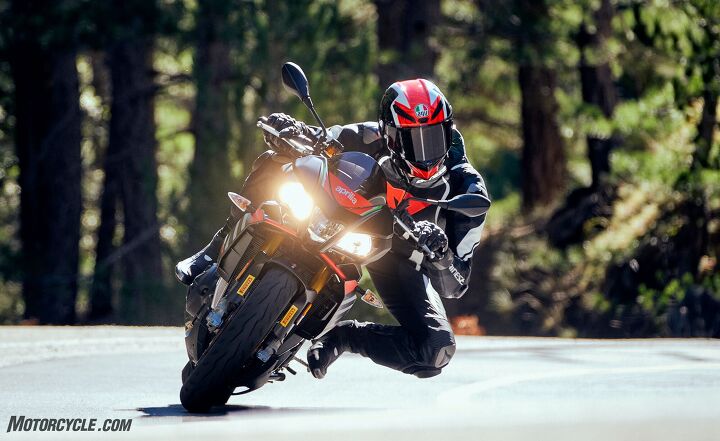
Yous don't take to ride like this to benefit from the advances in mod tire technology or the longevity afforded past proper intendance and maintenance.
However, tires even so depend on the end user to attain maximum performance and durability while they sacrifice themselves for our riding pleasure. So, I reached out to representatives from Avon, Dunlop, Metzeler/Pirelli, and Michelin to find out what we need to do (and why) to get the most out of our motorbike'due south safe.
The genesis of this article was a simple question from a forum that I frequent. Who knew that a single question could send me down a rabbit hole for months, but since the people that I was talking to were the engineering-focused types behind the development of tires, I learned very apace that the answer to my elementary question leaned, in many ways, on an agreement of many interlinked factors. Naturally, the answers to a sport-focused question would have a sport-riding-centric answer, simply there is still plenty to learn here for riders of other motorcycles.
The question that started this 5,500 word opus? "When sport riding, should street riders run the manufacturer'due south suggested tire force per unit area or something slightly lower for better grip?"
Choose the right tire for the job
Once upon a time, pretty much all motorcycle tires had like construction. They were blackness and round and were filled with air. So came the categories of tires. Then, you had the off-road tires, the touring tires, the cruiser tires, the sport-touring tires, the sport tires, and the race tires. Nevertheless, as engineering science marches forward, nosotros now take categories within categories. The contempo trend of track twenty-four hours tires is a great example. This all comes from the fine-tuning of the attributes that the individual tires feature from wheel fitment to carcass construction to tread chemical compound to tread profile and adds up to a huge menu of tires to cull from. In a recent conversation with representatives from Avon Tyres, I was informed that the visitor lists over 200 different tire specifications spread out over 10 unlike categories.
When you're choosing a tire for your motorcycle, you don't just want to throw any old tire on it, and for your ain sake, don't listen to the people who say it's safety to mount an automobile tire to the rear of a motorcycle. These people are conspicuously deluded and should not be trusted virtually anything – except, perhaps, the ambulance ride times to the local hospital.
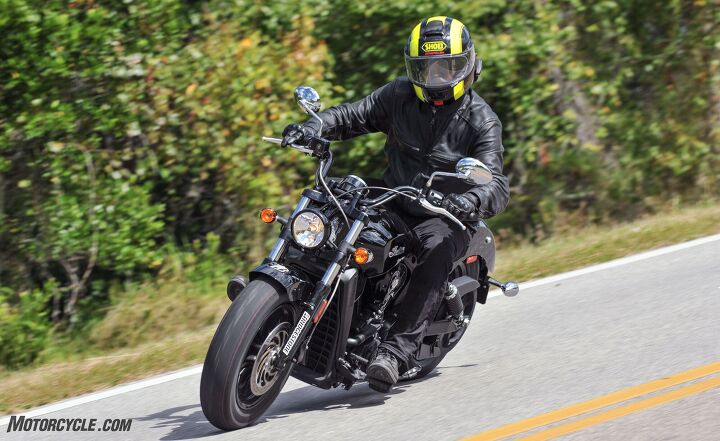
As with each category of motorcycles, cruisers take their ain special requirements for tires.
All four tire manufacturers I consulted agreed that to get the nearly from the investment in rubber, riders demand to buy the right model for their particular riding. Each had a list of questions for riders to consider, and when combined formed these common themes: What is the blazon of riding you practise? In what kind of weather condition? What type of motorcycle do yous ride? If you are a sportbike rider, are you looking for more grip or more mileage, and do you ever practise track days? Next, they recommended that less experienced riders talk to their local tire vendor. More experienced motorcyclists about likely have a pretty proficient idea of what category they fit into, just that doesn't mean they shouldn't do their due diligence. Tire applied science is changing incredibly chop-chop. Then, you lot need to pay attention.
What differentiates the categories of tires? At the nigh basic level, the differences beginning with two dissever only somewhat interrelated features: construction and load carrying capability. Bias-ply tires, for example, are quite adept at conveying heavier loads, which is why you unremarkably detect them on heavyweight cruisers and baggers. Bias ply tires run their carcass layers of cloth cords from bead-to-dewdrop in alternate layers at an angle (at a bias, which is how they get their proper name) to each other. This construction makes them stiff and strong – a plus for carrying heavy loads. Unfortunately, the additional thickness in the carcass presents a problem when it comes to shedding rut, which is less than optimal when it comes to sporting use.
Radial tires take their carcass constructed with their cords running directly across the tire from bead-to-bead perpendicular to the tire's rotation. This construction with fewer layers of trunk cord allows for a more supple sidewall, which helps brand the contact patch larger when the tire is on the edge of its tread. Non surprisingly, performance-oriented motorcycles primarily employ radial tires considering of the higher grip and improved feedback the more supple sidewall allows. Another feature of radial tires is their ability to take short sidewalls with wide treads. Look at your typical sportbike rear tire'due south dimensions. They only wouldn't be possible with bias ply tires.

Sportbikes aren't the just motorcycles that do good from radial tires. Touring bikes and cruisers can also take advantage of them.
However, that's non to say just sportbikes use radials. The Honda Goldwing comes with radial tires, and it is certainly a bike that is capable of carrying two large-sized people and their cargo. So, the lesson is that you should know what kind of tires your bike was originally fit with and continue doing so.
Next, riders should consider the rubber compound(s) that make up the tread of the tire itself. Those of united states of america who live for the side by side apex and can be seen carving up mount roads typically are willing to cede longevity for cornering capability and often opt for the stickiest rubber bachelor. However, you notwithstanding need to be enlightened of the conditions the tire you're mounting on your bike is designed to handle and what you're really doing with it. The long and short of it is that race compounds don't belong on the street.
Oscar Solis, Senior Roadrace Manager, Northward and South America Metzeler/Pirelli: "If you have a really sporty compound, if information technology's an ultra-race chemical compound like our Pirelli SC0, they're not fabricated to be at 120 degrees. They're made to be at 200-plus degrees Fahrenheit. Information technology'southward very hard to become that kind of heat in the tire on the street – with an SC0 or whatever kind of tire. So, your ultra-race compounds are actually going to be a harder compound at a lower temperature. Even if you had the skills to ride the bike to generate the estrus on the track, you most probable won't exist able to get that much estrus on the street. And then that's why you shouldn't accept race compounds as street tires."
This is not to say that performance riders don't benefit from buying the stickiest street tires they can buy.
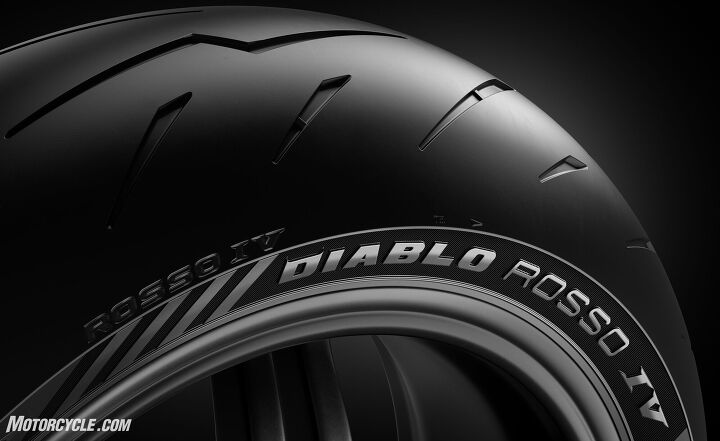
All motorcycle tire manufacturers are making tremendous strides in delivering gluey sport tires that don't habiliment out as quickly every bit those in the past. The Diablo Rosso Iv is Pirelli's most recent example. The stated areas of focus on the tire'southward development were "benchmark performance in both dry and wet" and "tread design optimized for sporty riding and regular vesture."
Oscar continues: "We'll expect at the Supercorsa SP. Information technology's a hyper sport tire, and information technology's very aggressive. It's a very gummy tire. Whenever I ask somebody what they're going to do with this tire, they'll say something like, 'I'm going to go commuting. I'thou going to get canyon etching. I'm going to the rails once in a while.' If you get to the track one time in a while and you're doing some canyon carving, the Supercorsa SP is cracking, and that actress corporeality of grip it offers tin can exist forgiving because information technology may allow you to brand some mistakes and have that safe net underneath you. If you have a tire that's mode more durable but less grip, that condom net might not exist there when you're asking for whatever degree of lean on the brakes and trying to miss a automobile because you were way as well hot coming into a corner. The grip level could really relieve your butt.
"Conversely, Supercorsas for a commuter bike, that's a waste of coin considering all yous're going to practice is wear out the center of the tire. Yous're only going to get five degrees of lean bending because you merely demand to pull into the vii-Eleven for some stuff. You lot'd exist much amend off with a sport-touring tire, an Angel GT, a Rosso III. Something that has more durability."
Dominic Clifford, Global Avon Motorcycle Manager, concurs: "Nosotros have a route-legal track day tire chosen the Extreme. Nosotros encounter this all the time, a rider volition come to united states of america and say, 'I want that tire. I don't care that I will just get 1500 miles out of information technology. That's the tire for me.' What we detect is that, in the road application, it is 100% the wrong tire for them. It's non just the mileage. In route application, information technology is very difficult to keep the rut in that blazon of tire. It is designed for track use, non for stopping and starting at lights, junctions, etc."
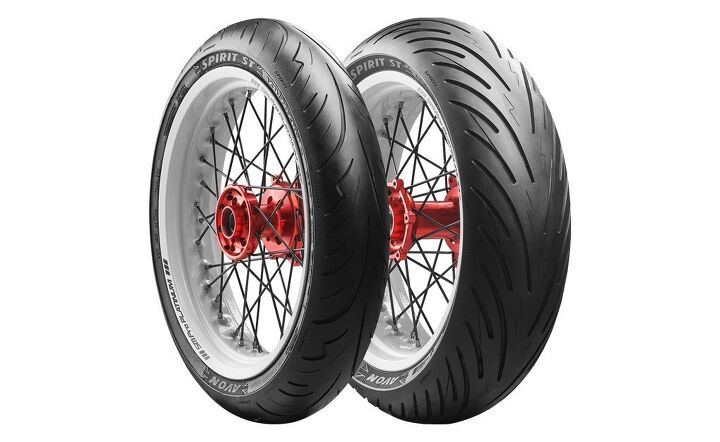
A quick glance at the Avon Spirit STs above tell you that this sport-touring tire was designed with wet-weather grip in mind (in England, that'due south of particular importance) forth with dry-weather condition functioning.
The difference between hypersport street tires and sport-touring tires is almost more than simply the rubber compound. You lot as well need to consider the difference in carcass stiffness and tread profile and how they bear upon handling.
Ashley Vowles, Avon Motorcycle Tire Development Manager: "From a tire standpoint, they are designed very differently specifically to application. Hypersport track tires are designed to exist very stable at high-speed. They're designed to provide optimal grip at higher operating temperatures, and the profiles are designed a lot sharper to enable the bike to turn it in and fall right onto the edge of the tire when the rider is going around corners and hitting the apexes.
"When looking at sport-touring tires, they are slightly similar to hypersport tires, but the construction is slightly different. The track tire/sport tire has quite a lot stiffer construction so that the rider gets optimal feedback from the tire. Whereas sport touring is slightly softer in structure to improve rider comfort. Simply also the contour is slightly flatter than a sports tire. Sport-touring tires offer a piddling more footprint because they're upright a lot longer than on a sport tire.
"Also, you generally get dual compounds on the rear of those tires. The sport-touring tire is designed for high mileage. Sport-touring tires people kind of refer to them every bit the all effectually, all flavour type tire. People are commuting on them. People are using them all twelvemonth round. They've got good dry performance, good wet performance, skillful longevity, good handling and stability."
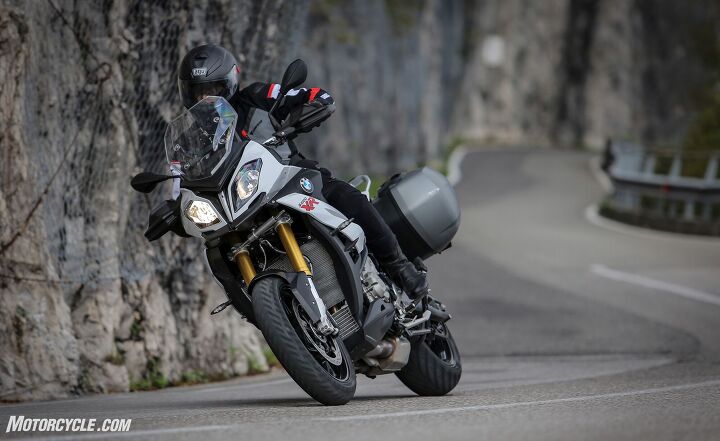
Sport-touring tires are probably the closest to a universal motorcycle tire. They offer a great balance of moisture- and dry out-atmospheric condition grip along with good wear characteristics.
Daily commuters would be throwing money away on the stickiest rubber in their workday crash-land-and-grind, when sport-touring tires offer nigh the same grip on the street while delivering many more miles per fix.
However, the decision doesn't finish with but the compound. Tire pick also depends on where the rider lives. A tire with the blank minimum of sipes – as shut to a slick as possible – will suit riders in the arid Southwest or riders who never ride in the rain, only enthusiasts from wetter climates capeesh the ability to channel water away from the contact patch in addition to dry grip. Since cruisers and tourers are less interested in outright lean angle than comfort and longevity (plus wet weather functioning for the travelers among us), these tires emphasize durability and the ability to handle the forces that the public roads throw at them and the heavier loads they tend to carry. Finally, we can't ignore the role that styling plays in tire choice.
Tire Force per unit area is key
Now, nosotros arrive at the impetus for this commodity: How do riders become the most out of their tires? Nosotros've heard most special pressures for track days. Should passenger'due south vary their pressures for different street-riding jobs? Or should they set their tire pressures (which they are checking at least weekly, right?) to OEM specifications and not worry virtually information technology at all?
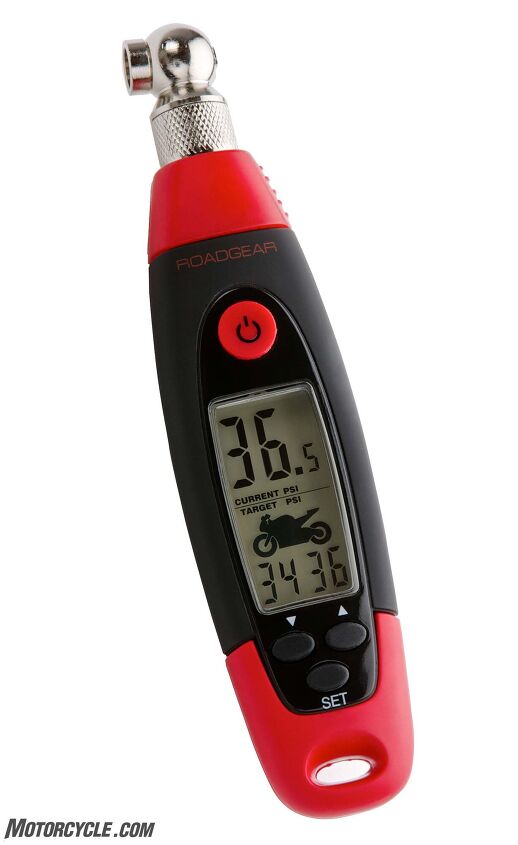
If yous accept away nothing else from this article, empathise that the cloak-and-dagger to getting both the best functioning and durability out of your motorcycle tires is to buy an accurate tire pressure gauge and to use information technology regularly.
Amid the tire companies I consulted, the unanimous statement was that you couldn't go wrong with running the OEM-recommended pressures on the street. Nonetheless, at that place were some caveats.
Vowles @ Avon stated: "For xc% of our tires, nosotros recommend the OE pressures for that motorcycle…There are a few sizes and few bikes where we do recommend a different pressure level, on our custom stuff, especially, where nosotros might have a slightly higher force per unit area."
Clifford @ Avon adds: "Tire pressures are very of import. Yous should be increasing your pressures if you're riding with baggage and pillion. The pressures we recommend are for cold tires in a road application. If you are going to ride with a pillion and or luggage, nosotros'd always recommend increasing 1 or 2 PSI in that tire as well."
Shawn Bell from Sumitomo Prophylactic USA (Dunlop's parent visitor) concurs: "The first affair I recommend is check with the motorcycle manufacturer. They have platonic air pressure level settings when it comes to the capabilities of the motorcycle. We actually have a 1-800 number (800-845-8378) that we get a lot of customers calling in and asking questions like this, and nosotros always recommend running OE placard pressure on the street."
Michelin responded in a written statement from its engineering department: "For street riding purposes, Michelin recommends the tire force per unit area quoted past the motorcycle manufacturer…Road pressures are divers by the motorcycle manufacturer to cover all possible uses of the motorcycle, ranging from slow speed commuting to work in an urban environment all the way to 2-up on the highway (high speeds sustained in a straight line)."
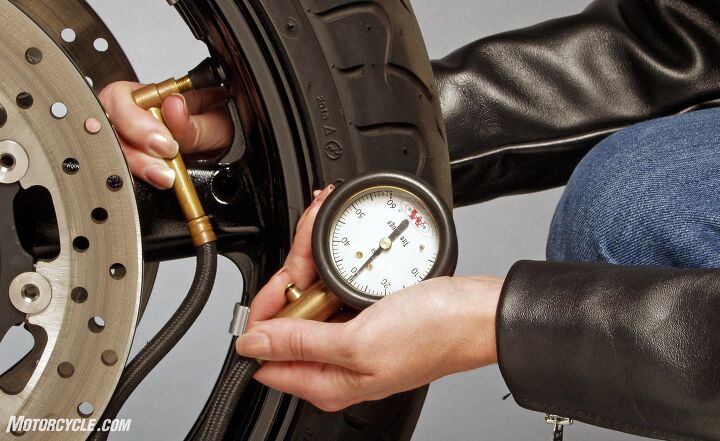
For a regularly-ridden motorcycle, weekly pressure checks are the minimum. Still, according to the tire reps, nosotros should practise it before every ride.
Solis @ Metzeler/Pirelli, said: "It's always going to be the cycle manufacturer's recommendation. They build the bike. When nosotros build a tire, it's not necessary we build the tire for every motorcycle. Instead, nosotros build a tire that tin can go on a handful of motorcycles. It's the bike manufacturer'due south pressure recommendation because information technology is more of a singular application for the bike and passenger than just the tire itself."
So, the mutual thread in all of this is that the OEMs know what the motorcycle is capable of and the kind of stresses that information technology will put on the tires in the range of operating conditions expected of it. The cynics among usa will say that this is largely a CYA statement to avoid lawsuits, but the engineers and examination riders responsible for developing street bikes really know what they're doing.
The about common mistake
Let united states interruption for a moment of silence to consider the suffering inflicted on motorcycle tires by neglectful owners – and let their tales of woe be a warning.
Bell @ Dunlop: "At rallies, we would set up a tire check, people would come up through with their motorcycle, and nosotros would check their weight and pressure. We'd have them roll up on the scale and sit down on the bike with everything, their luggage, the wife on the dorsum, and nosotros would get the weights front and rear. Then nosotros would bank check their force per unit area. And the number of under inflated tires was surprising. We even came across some riders with less than 10 psi in their tires. Information technology was kind of scary and comical at the same time. We're telling people, you don't understand how of import this is.
"We found in our testing that yous're going to get the all-time mileage bang for your buck on the street if you maintain the placard pressure level. As shortly every bit you lower that pressure level, yous're putting more heat cycles into the tire. You're definitely generating more flex in the carcass, and that'due south going to wear the tire out. I couldn't tell you lot how much quicker. I know that it's pretty obvious to me when I accept seen a street motorbike running too low air pressure, either it wears out too quickly or wear is uneven. You go cupping."
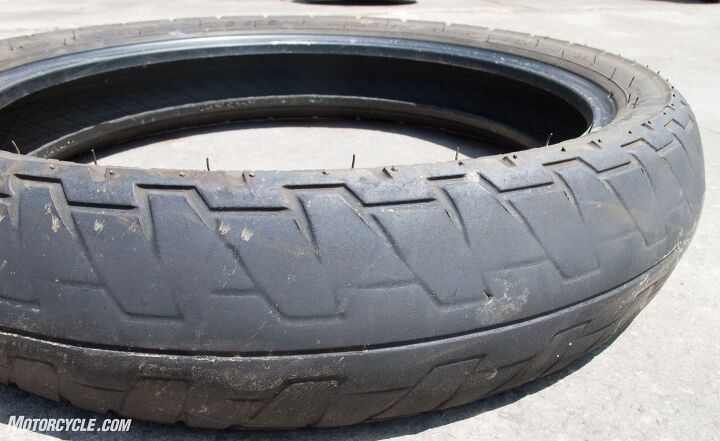
This basket instance of a tire shows articulate signs of being used while under-inflated. Notation the cupping of the tread while the centre still has safe left.
Solis @ Pirelli: "Bank check your force per unit area. Every time you become out on a ride. Nobody ever does it, just I'm still going to suggest that you do it. Check your pressure every time – particularly when the weather condition changes. That'southward what really changes the pressure level in the tire. Heat is generated in a tire by deflection, past how much it squishes, basically. On the route, less pressure level is going to create more than heat. That's why big truck drivers in semis get blowouts when the pressure level is besides low. It creates more oestrus. The heat's non so much on the surface. It'south really under the surface. That's why you run into the tread come off."
Clifford @ Avon: "The 1 stat that I always talk about is that you lot should look at tire habiliment as a bell curve. The optimum pressures in the middle. If you become x percent either manner on your pressures, then tire wear literally drops off the bell bend.
"So, your optimum article of clothing charge per unit is at 42 PSI. If you go plus or minus on the x% dominion, and a lot of riders will for a 42 PSI recommendation. They will probably drop that down to 34 or 35, just even 10% so from 42, that's about 38 PSI. Even if yous're 38, that will, in some cases, increase your habiliment charge per unit by 50%. So, yous volition go half the mileage out of your tire by running it betwixt 35 and 38 than you would do at 42 PSI."
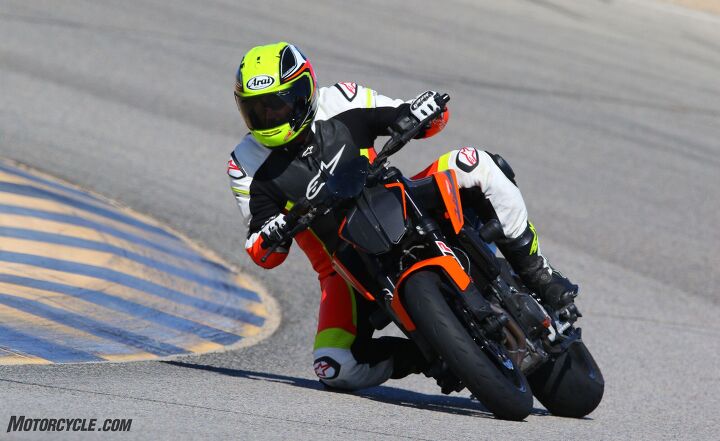
Track pressures are for the track, and street pressures are for the street. There is actual science backside these settings.
Vowles @ Avon addresses the desire for a bigger footprint provided past running slightly lower pressures when sport riding. Moderation is the key hither: "Yes, you are going to potentially accept a bigger footprint, but at the same time you're as well going to modify the complete structure of that product because information technology's going to be a lot softer in the sidewall. It's going to wallow around; you're going to wear the tire out. You're going to have tires moving around, which can generate more heat likewise. So, yous tin can risk overheating the tires. Now, it may be that on some bikes an end user, instead of having 36/42, he's gone 34/40, and he likes it like that. Okay, that'southward okay."
To wrap up this section, it's time to go really honest with yourself. When did you last check your wheel'southward tire pressures? If it was in the last week, you're better than most. If you can't recall, yous could, at best, be throwing away money on rubber that you're wasting and, at worst, endangering yourself (and others). Motorcycle tires are serious business.
Track pressure is a special example
The track environment is quite different from the street. The extreme loads are nearly constant, going from braking to full-throttle acceleration dorsum to braking and leaning over in a corner. This generates heat quickly and tin can button tires non fabricated for the environment well out of their temperature range and cause them to become greasy. Another component of the heat build up in tires on the track is how it affects pressure rise.
Michelin puts things succinctly in its written argument: "Excursion pressures are traditionally defined by the tire manufacturer for track use only. It is not recommended to ride on the road with these pressures.
- "For track utilize, the front end tire force per unit area is lowered then that when it is hot, the tire operating temperature is close to the cold road pressures.
- "The rear pressure is lowered significantly on track versus street considering the pressure needed to back up two-upward is not required and thus a lower pressure achieves a more than optimal operating temperature."
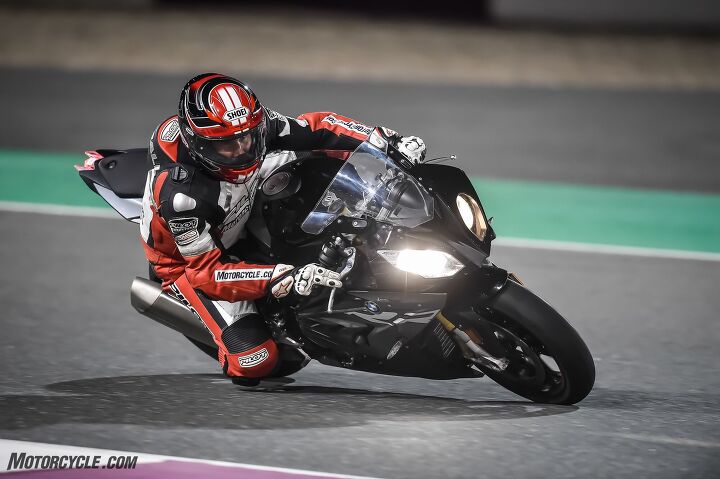
Track pressures serve multiple purposes. First, the lower pressure level helps to manage the increment in tire pressure level every bit the carcass temperature rises. 2nd, the size of the rear contact patch can be adjusted to give better drive out of the corners.
Bell @ Dunlop reveals that the consequence is about more than than just tire temperature. For case, street settings have college rear pressure level than front end, but at the rail things are reversed: "[On the track] the lower pressure level on the rear is considering of the benefits of the increase in contact patch that y'all'll go, specifically for the drive out of the corners. The air pressure on the rear, when it gets hot, increases more than the front. If you started off with 32 in the forepart and 30 in the rear, yous're gonna end up with 36/36 hot. Simply because of the book of air inside the tire, you're seeing a bigger increase on the rear.
"I ever say that it's important to check the hot pressure because, when you're on the rails, you're not normally riding on cold tires. You lot're on hot tires. If you want to hone in on air pressure, I recommend checking the hot pressure, only you have to beginning with something. You have to starting time with a cold pressure [which is information that a tire vendor will have]."
Solis @ Metzeler/Pirelli emphasizes that novice track riders or riders that don't accept track feel with the tires they're running should talk to a tire vendor: " When yous take tires to the rails, talk to somebody. Talk to trackside vendors near pressures. Yes, yous go lower to become a piffling more grip, just they'll assistance you lot out with the specifics of those pressures and make sure that you lot're non going to overheat your tires. With true rails race tires, information technology's very very hard to overheat them. About of the time, it'due south the rail that really loses a lot of grip when it gets also hot. You accept to continue in mind that friction is from two parts, the tire and the track. Maybe the tires lose their grip and perhaps information technology'due south the track losing grip. A lot of the time, people don't realize the track loses its grip, and you lot have to do something with the tires or suspension to kind of compensate for that."
The final word on track tire pressure is talk to the people who know the tires you lot've mounted and then, if you take the skill set, conform from at that place to suit your preferences. If you're new and don't accept the skill ready, and so we'll reiterate the importance of contacting a reputable tire vendor ahead of time to seek proper tire pressures to starting time with. Odds are yous'll stick with these pressures for the whole day. Think that non every tire brand will take a representative at your track day. Then, again, get the information you demand prior to arriving at the track.
On running not-standard tire sizes
This topic can get fairly far off into the weeds if y'all include custom cruiser show bikes that are all about the grade with fiddling – if any – idea near how the bike will handle. Still, a surprisingly large number of riders think that the hot set upwards is to put larger tires on their bikes. Hither's what the tire reps had to say about it.

We're going to proceed our focus on motorcycles that are actually designed for riding.
Again, Michelin wins points for brevity, getting to the crux of the matter: "For street riding, motorcycles should be equipped with the size of tire specified by the motorcycle manufacturer. Do non mount tires wider or narrower than the original-equipment tires, either of which could negatively affect the motorcycle's handling. Exceptions to this guidance should but exist considered with qualified tire support specialists; i.e. trackside tire support (190 rear width vs 180 rear width, etc.)."
Solis @ Metzeler/Pirelli says you should bank check with the tire and wheel manufacturers' specifications: "When we create a tire and when we engineer a tire, nosotros actually engineer for a sure size rim. As long as the tire manufacturer says the awarding is for this rim size, then it's been tested that way. A 180 to 190, the contour doesn't mean it'south the same right? The profiles are different. If you go with a different size with the same rim size, it'south going to pinch the profile. What happens is it kind of curves a little bit more. When information technology's on the street, that means that it doesn't quite go all the style to the side of the tire. It kind of stays upwardly a little bit more on the tread. That could be bad because, when y'all go all the way to the side of the tire, you deflect the sidewall a piffling bit more and, actually, may have more of a contact patch. Y'all are squeezing that side wall a picayune scrap and getting a bigger contact patch. Not a lot of people sympathize that. They think it's just wider, and it'southward meliorate: 'Just pinch that puppy on there. Y'all're going to accept more contact patch.' But they might actually accept less.
"The other problem well-nigh information technology is that the choice of the tires might actually be less besides. The range of tires that y'all have a certain size may be dissimilar. If your bike manufacturer recommends it, fine, go with it. If it doesn't then, you know, information technology's going to change and y'all might take less availability for your bicycle."
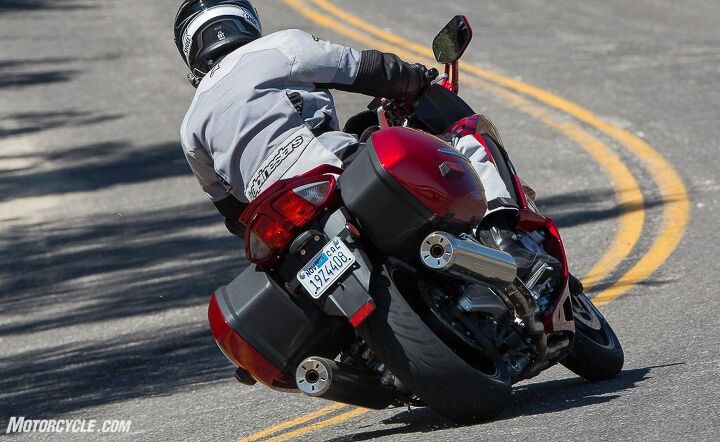
Most riders don't spend much fourth dimension thinking near it, only a lot of testing goes into the development of tires and how they affect a motorcycle'southward handling. Cull non-standard tire sizes, and you could screw things up.
Bell @ Dunlop: "There are two schools of thought. I think if somebody is going to entertain the idea of trying a non-standard size, something that's different than the motorbike manufacturer recommends, they should practice as much homework as they tin can. I wouldn't recommend but going off of the blogs because somebody said that they did it, and it was awesome. They should endeavour to really empathize what they're doing to the motorcycle because the geometry of the motorbike is just like air pressure: the manufacturer set up the interruption and the geometry of the motorbike for its platonic handling. As soon as you change that, you could potentially upset the treatment of the motorbike.
"The data that's gonna exist important is the diameter, because yous tin can alter the ride top. Not only are yous changing the width of the tire, but depending on the aspect ratio, y'all can too change the bore. Y'all're essentially raising or lowering the eye of gravity. That might be great for a track day because yous desire the quick steering, but I think they should endeavour to understand what they're doing.
"Clearance with the swingarm is important. Tire size changes at speed. The dimensions we publish are static. That'south not dynamic. Luckily, sport tires are pretty stable. Bias ply tires abound quite a flake. Equally soon as you start throwing in a wider tire or a taller tire, and then you run the risk of interference. My recommendation is that they just need to practise their homework and brand certain that they're doing the correct thing.
"I know personally, spending as much time every bit I have at the runway, a taller attribute ratio is better for the runway. A taller contour gives a bigger footprint when leaned over. It gives quicker handling. Once more, those are all things that you want at the runway, but is that what you want on the street? That's another question. It actually comes down to where yous're gonna ride."
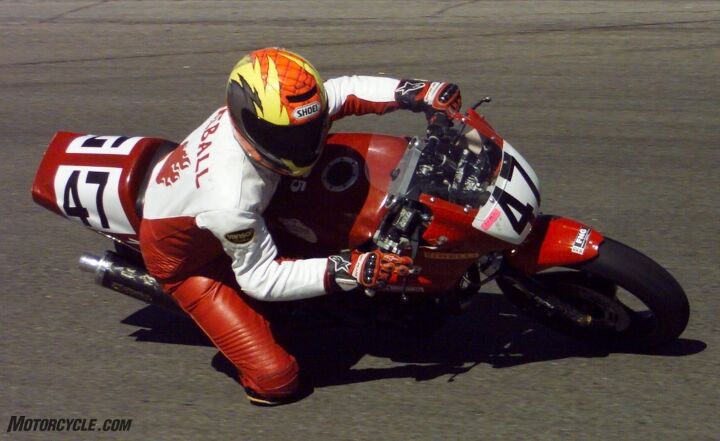
If y'all look closely at the leading edge of the front fender, you'll see that my plumbing fixtures a taller than stock tire caused it to rub confronting the fender as the carcass expanded at high speeds.
Clifford and Vowles from Avon tag-teamed on this answer:
Vowles: "So if y'all've got a five-and-a-half inch rim on the back of your sports wheel that's designed for a 180, and you want to put a 190/55 or 200/55 on, you are going to dramatically change the performance of a motorcycle. Tires on narrower rims will change the profile. If the tire is designed to exist on a half-dozen-in. rim, and yous're going to put it on a 5-in. rim, you're going to sharpen the profile."
Clifford: "When you mix in a motorcycle designed for a certain fitment, somebody may put a different size rear tire on. What we observe then, in certain situations, is that the forepart tire and the rear tire aren't working in harmony. And then you cease upwardly with a shimmy, particularly on a sweeping curve because those profiles are non matched. So, they end up working against each other."
Vowles: "Yous've got one that wants to plow in and the other wants to stand up. It'southward our worst case scenario in the tire industry. A motorcycle manufacturer or a tire manufacturer would steer away from that at all costs. Nosotros could not always recommend anything we've not tested in awarding. Always, always stay with your recommended tire size."
Wrapping it upwardly
While reading this commodity, yous probably noticed that the manufacturers agreed with each other on the broad strokes. These are demonstrable truths that their companies have learned through R&D. You should admittedly heed this advice. In the cases where there are slight differences in their arroyo to a topic, some wiggle room is implied, meaning that if you know what y'all're doing or consult with someone who does, there is room for you to find what works all-time for you.
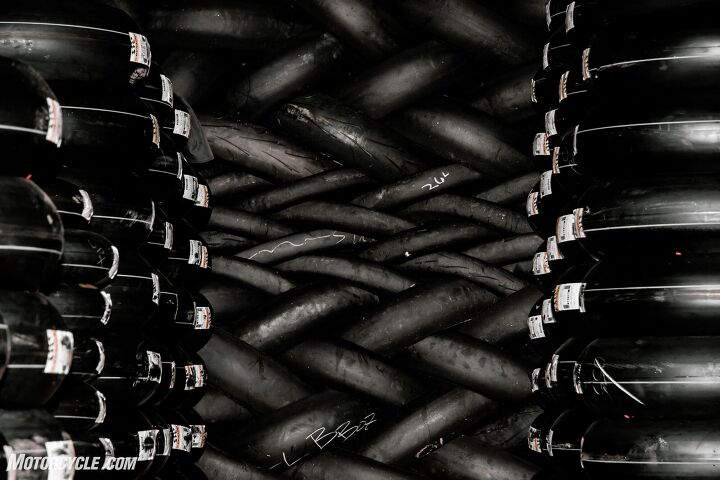
Why would Dunlop haul all these used race tires away from the rails? To written report and larn from. Street riders volition somewhen benefit from the technology developed at the runway.
FAQ?
Should motorcycle tires be inflated to max PSI?
There is some confusion as to what the Max PSI listed on a tire is. This figure is generated for the motorcycle'southward maximum rated load and the pressure level required to back up that load. Equally the tire force per unit area goes down, the maximum load the motorbike tin can deport is reduced. Of class, motorcycles spend niggling of their time conveying that maximum load. So, for regular use, consult the motorcycle manufacturer's recommended tire pressure to attain optimal results. These volition be the pressures that information technology was designed to operate with.
What happens when a motorcycle tire pressure is depression?
Kickoff of all, your motorcycle's treatment volition exist afflicted because the tire's carcass will not maintain its proper shape. Steering will feel heavy. As stated in the article above, depression tire pressure puts more heat cycles into the tire because it's generating more flex in the carcass. At its best, the tire is going to habiliment out sooner, wasting the money y'all invested in it. At its worst, low pressure could lead to catastrophic tire failure.
How ofttimes should I cheque my motorbike's tire pressure?
The best answer, the answer tire manufacturers always give, is to bank check tire pressure before every ride. The realistic answer is that for a regularly ridden motorcycle, a weekly bank check is sufficient. However, if your bike sits unridden for any length of time, definitely check the pressure earlier you lot ride it again.
Additional Resource
All-time Motorcycle Tires
All-time Sportbike Tires
Best Motorcycle Racing Tires You Tin Also Use On The Street
Sport Touring Tire Heir-apparent's Guide
Adventure Tire Buyer'south Guide
Best Motorcycle Touring Tires
Best Motorcycle Cruiser Tires
All-time Dirtbike Tires
How To Properly Check Your Motorcycle's Tire Pressure
We are committed to finding, researching, and recommending the best products. Nosotros earn commissions from purchases you make using the retail links in our product reviews. Larn more than about how this works.
Become a Motorcycle.com insider. Get the latest motorcycle news first past subscribing to our newsletter here.
carringtonroas1945.blogspot.com
Source: https://www.motorcycle.com/features/black-magic-motorcycle-tires.html

Post a Comment for "Everything You Need to Know About Mortotcycle Tires"